I built a survey with one simple aim. Find out what AI is really doing to a business. Not just what it earns, but what it saves, and what it costs to run.
Six questions. Ten minutes. No email needed.
Fourteen people finished it.
I ran it for weeks. I pushed it out several times, across every channel I have. If I kept nudging you to fill it in, sorry about that. Plenty of people started. They answered the first few easy questions and then stopped. As market research it did not work, and I am not going to pretend otherwise. But the way it failed is the interesting part.
The people who stopped all stopped in the same place. They were happy to say how much AI they had rolled out and whether it was making money. When I asked what happened to the time it freed up, or how they decide what to spend on AI, the answers dried up. That pattern was worth more than the responses I was chasing.
So I asked the same six questions a different way. Instead of asking companies, I read what they already say in public. I scored 120 large software companies from their annual reports, their earnings calls and their product pages. One rule: a claim only counts if there is a dated source behind it. Where a company says nothing, I marked it as nothing. I did not guess.
Here is what 120 companies and 720 answers show.
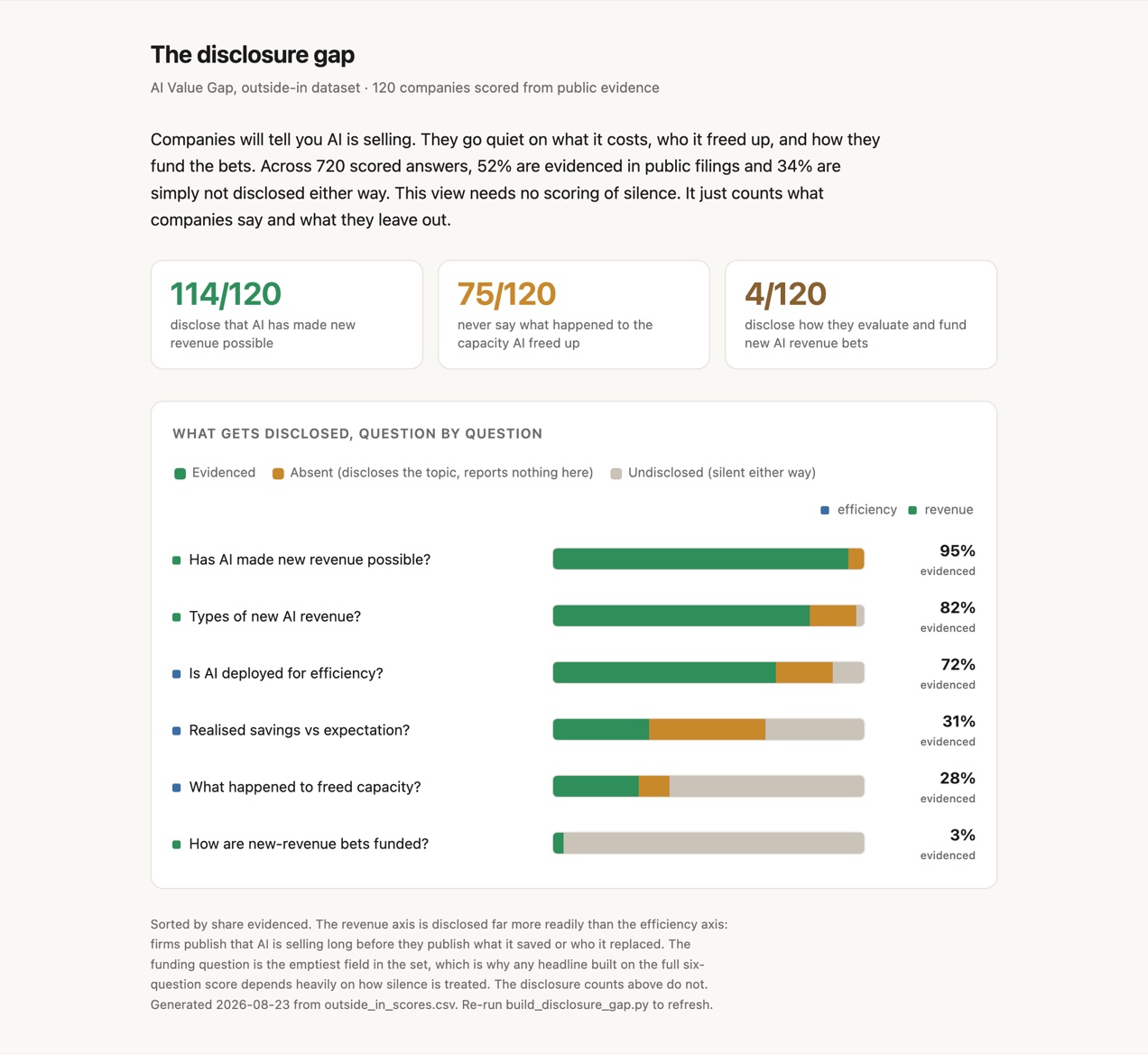
The money AI brings in is the easy half. 114 of the 120 say where they stand on new AI revenue, and 92 say it is already live or growing. Companies are glad to tell you AI is selling. Adobe says annual recurring revenue from its AI-first products passed 500 million dollars and tripled in a year. Zscaler said last November that its AI Security products had beaten a 400 million dollar target three quarters early. The revenue numbers are loud and specific.
Now the two harder halves. What AI saved, and what it cost to get there.
75 of the 120 say nothing about what happened to the capacity AI freed up. Three quarters of them will tell you AI made the work faster. They will not tell you what happened to the hours, or to the people who used to do the work. And only four companies out of 120 say how they decide what to spend on AI and whether it paid off. Four.
Add up all 720 answers and about a third are simply missing. No information either way. The gaps are not random. They fall on saved time, on headcount and on spending decisions, the same places the survey respondents went quiet.
This is the part you can only see if you have run one of these companies. The money coming in is the half you talk about, because it looks good. What you saved, whose job went, and what you are spending to keep it running: that is the half you keep to yourself. The honest answer is usually one of two things. Either "we do not measure it" or "we cut people." Neither goes in an annual report. Neither goes in a survey. There is nothing sinister in it. It is what happens when the true answer is uncomfortable.
Underneath all this is something simpler. The revenue is the part you can put in a press release. The change behind it is the hard part. Redeploying the people whose work AI took over, or letting them go, and funding the whole thing with enough discipline to know whether it worked. That is slow, unglamorous work, and plenty of companies have not done it well. Nobody briefs the market on the part they have not cracked. So they report the revenue and go quiet on the rest.
There is a good reason companies stay quiet, and its name is Klarna. In early 2024 Klarna said its AI was doing the work of 700 support agents and saving about 40 million dollars a year. It was the loudest AI-saving claim in the market. About a year later the same chief executive was rehiring humans and admitting the cost-cutting had hurt service quality. The saving looked real on the slide and did not hold up in the end. Every other CEO watched that happen. It is a large part of why they will not put their own numbers on the record.
Let me be clear about where this holds. I am talking about B2B software and SaaS. I am not talking about pharma, medical devices or clinical care, where the rules and the pressures are different.
The hardware companies show the same thing from the other side. Mettler-Toledo uses AI inside the business to help its engineers fix problems faster, and sells no AI product at all. Bio-Rad calls AI a feature for 2026 and puts its actual margin gains down to supply-chain work. The companies with the least AI to sell are the most straight about what it is doing for them. The ones with the most to sell are the quietest about what it costs to run.
A few companies do show more of it. Salesforce is the clearest. It cut its support team from about 9,000 people to 5,000 as AI took over half its support cases, and its chief executive said so plainly. The revenue and the headcount, both on the record. That is rare. And even Salesforce does not say how it decides which AI bets to back and which to kill. Almost no one answers that one.
So here is what it comes down to, at least in software. A software company will tell you what AI earns. It will not tell you what it saved, what it spent to get there, or whose job it changed. You get the number that looks good, and none of the ones that don't.
The real answer will not come from those filings, and it will not come from a cold survey. I have proved that second one on myself. It comes out in private, in conversations about the hard part. What changed, who it changed, and whether it was worth it. That is the work I am doing next, and it is more useful than any form.
The survey is still open, if you want it. I do not think a form will ever get this answer out of anyone. If you think I am wrong, go and prove me wrong. The honest answers come in private
.