If you sell software or AI into pharma R&D, the first commercial question is which large company to go after first. Reading 25 companies one by one does not answer it. A comparison does, as long as everyone is clear that it rests on public information.
So I built one. The Life Sciences Radar on ortent.co scores 25 large pharma and biotech R&D spenders, chosen on FY2025 reported R&D expense, on two themes: AI and computation in drug discovery, and the digitalisation of research labs and scientific data. It is free.
How the scoring works
Each company gets two scores per theme. Priority, from 1 to 10, is how much weight the company puts on the theme in its own disclosures. Delivery, from 0 to 10, is how far its published evidence shows the work running.
Delivery climbs in fixed steps: a plan, a funded commitment, a build or pilot, a named system running (4), measured adoption (5 and 6), a measured result the company ties to the work (7 and 8), and a result sustained over time (9 and 10).
Every score opens the quotes behind it, with links. Each company also has a plain brief: its scores, the quotes behind them, its commitments, its open R&D roles and two questions a supplier should look into. Across the radar and the briefs there are nearly 500 linked public sources, all published up to 5 October 2026. Job adverts, vendor marketing, pages with no date and private knowledge never count towards a score.
The lab theme covers lab automation, electronic lab notebooks and LIMS, and scientific data foundations. Process and CMC development are grouped with manufacturing and left out.
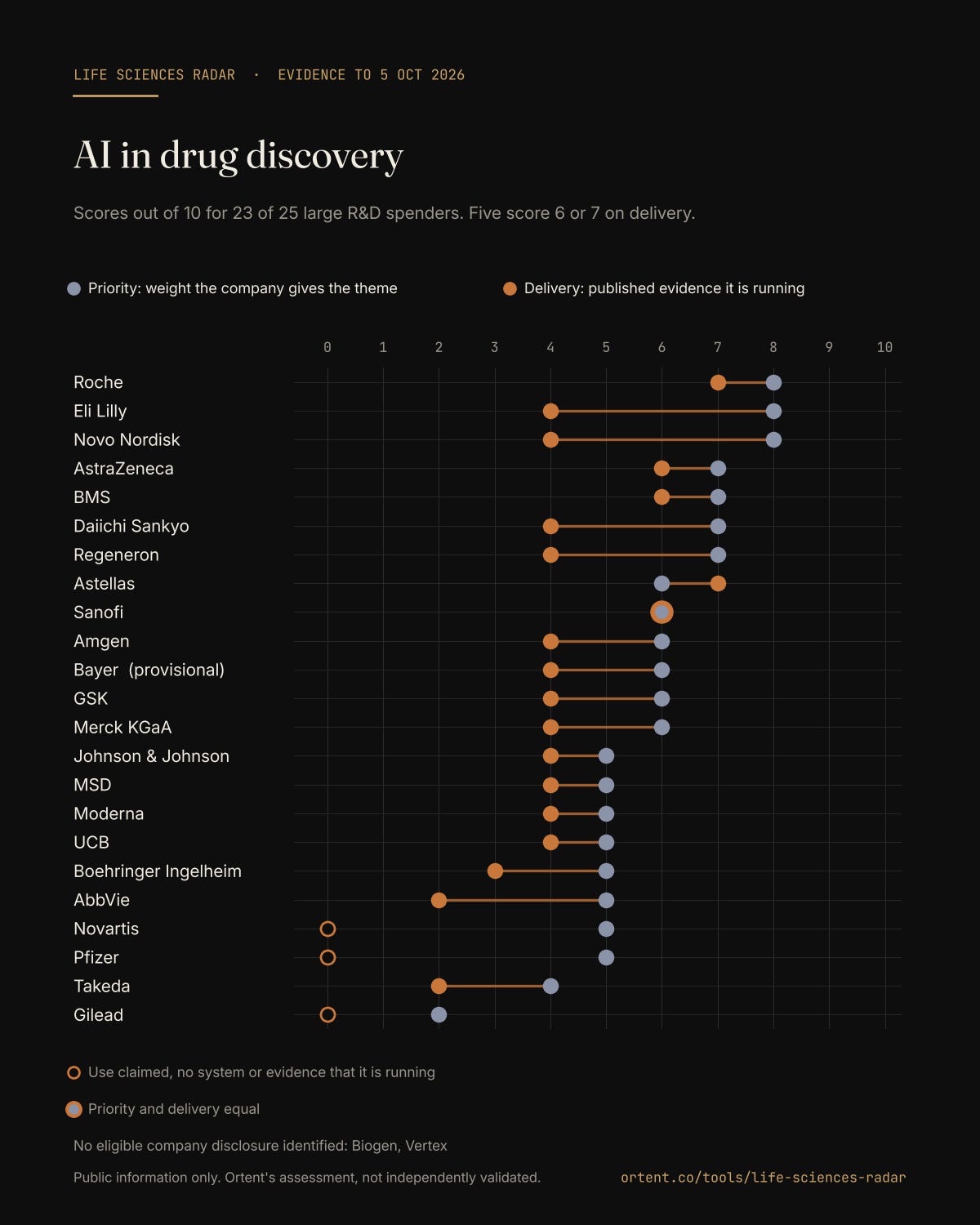
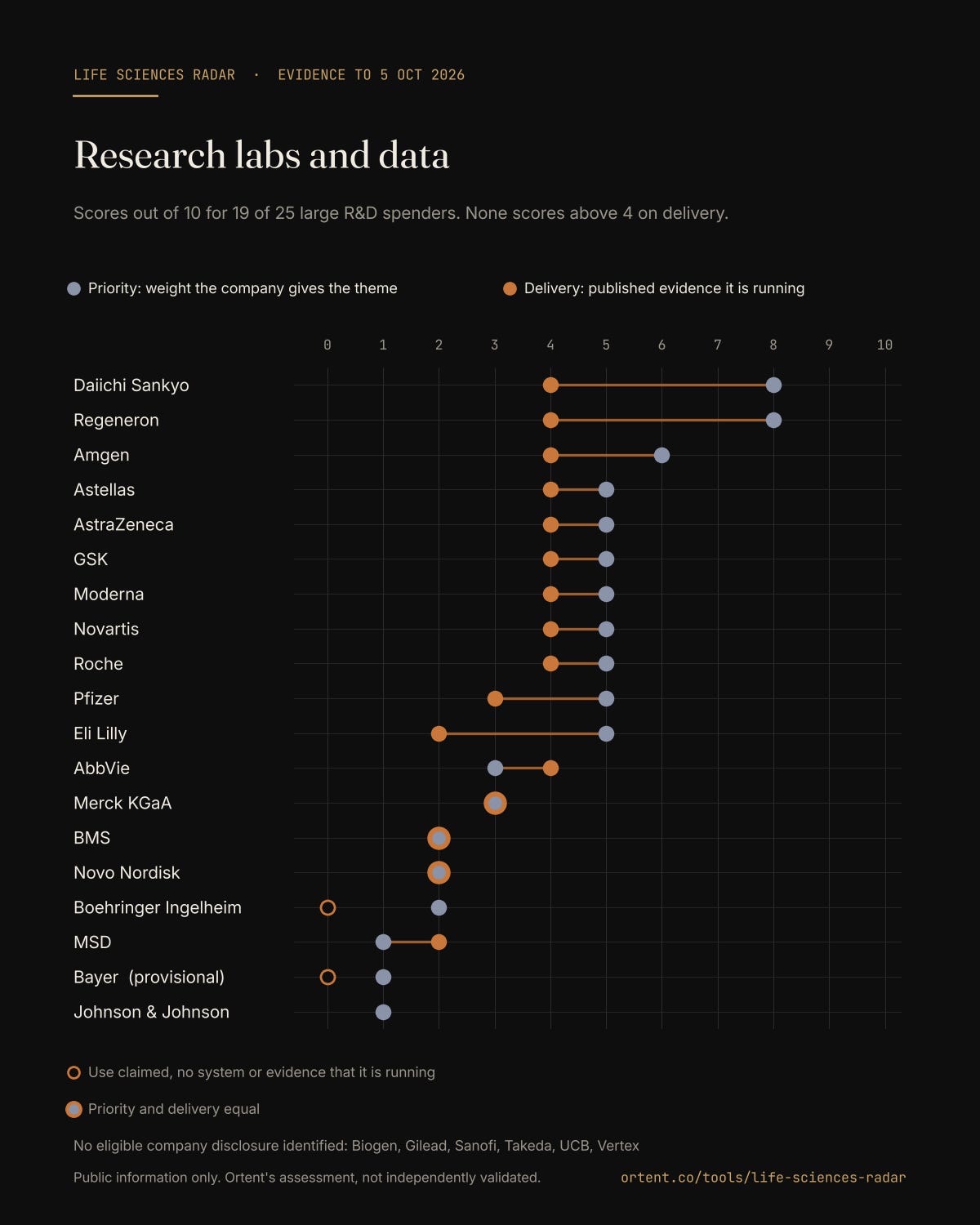
The two charts below read the same way. The grey dot is Priority and the copper dot is Delivery, so the line between them is the gap. A hollow copper ring means the company claims use but names no system and shows no evidence that it is running. Companies with no eligible disclosure are listed under each chart.
AI in drug discovery
The clearest thing in the data is the contrast between the two themes. 23 of the 25 have eligible public disclosure on AI in discovery, and the median Priority is 6.
Five companies publish measured adoption or a measured result, and score 6 or 7 on Delivery: Roche (7), Astellas (7), AstraZeneca (6), Bristol Myers Squibb (6) and Sanofi (6). Roche's 7 rests on a single programme in which the company compares an AI-designed molecule with the original lead. It is a company-reported case, not a controlled result.
Three companies say they use AI across R&D but name no system and show no evidence that it is running: Gilead, Novartis and Pfizer. Their Delivery shows as "claimed".
The widest gaps between Priority and Delivery are at Eli Lilly and Novo Nordisk (Priority 8, Delivery 4), and at Pfizer and Novartis (Priority 5, Delivery claimed). For Biogen and Vertex the radar found no eligible company disclosure on this theme.
Research labs and data
The lab picture is different. 19 of the 25 have eligible disclosure and the median Priority is 5. No company scores above 4 on Delivery. Ten show a named lab system running. In the sources reviewed, none publishes a measured adoption figure or result for its research labs.
Daiichi Sankyo and Regeneron put the most weight on it (Priority 8), then Amgen (6). All three score 4 on Delivery.
Six companies sit together at Priority 5, Delivery 4: Astellas, AstraZeneca, GSK, Moderna, Novartis and Roche. The scores pick out the leaders and the companies that say nothing, but they cannot tell these six apart. To compare them, open the quotes.
Six companies have no eligible disclosure on this theme: Biogen, Gilead, Sanofi, Takeda, UCB and Vertex. That does not mean they are inactive. Sanofi's automated CMC lab, for example, counts as manufacturing in this radar.
What the companies are doing, not just saying
Beside the scores, the radar now shows observed activity. That is the commitments each company made public in the last 12 months (partnerships, licences, compute, research units and ventures) and the R&D roles open on its job site on 6 October 2026. It is a count of public signals, not a score, and it never changes Priority or Delivery. It has its own Activity sort.
It confirms the contrast. In the year to 5 October 2026 the 25 companies made 78 AI discovery commitments public, against 11 for research labs. Boehringer Ingelheim leads on AI with 8, then Bristol Myers Squibb, Eli Lilly and Sanofi with 6 each. Boehringer's Delivery score on AI is 3.
Takeda shows why the layer matters. It has no eligible disclosure on research labs, yet it made 2 lab-data commitments public and had 9 lab-related R&D roles open. A company can be quiet in its own reports and still be committing and hiring.
Many of these deals reach the public through the partner first. 41 of the 78 AI drug discovery commitments were published in the partner's release, not the company's own.
What it means if you sell software
A high Priority with a low Delivery is where a company says the theme matters but has not shown it working. In software sales, that gap is the usual opening for a vendor. Before a first call, the quotes behind each score show what the company has already said in public about the theme, in its own words.
On research labs and data, no company publishes a measured result. A software company that can help a pharma customer show measured results from its lab systems would have something none of the 25 currently shows in public.
What the radar is not
It is Ortent's assessment and has not been independently validated. It uses public information only, published up to 5 October 2026, and coverage varies by company: some sites block automated research, and some documents could not be read in full. A low score can mean a company says little in public, or that the radar could not reach some of its sources. It does not predict buying intent, and it does not measure how mature a company's operations are.
Disclosure: I was Chief Growth Officer at Sapio Sciences, a lab software company, until April 2026. I have no current relationship with, or financial interest in, Sapio or any other supplier.
Tell me what I missed
Open the radar, pick a theme, sort by gap or by activity, and open the quotes. If you know of a public source the radar missed, use the report form on the radar page. Nothing is published automatically. Reports are checked and go into the next quarterly refresh.
The radar: https://ortent.co/tools/life-sciences-radar/
How it is scored: https://ortent.co/tools/life-sciences-radar/method/
If you sell into the NHS rather than pharma, the NHS Board Radar is the sibling tool: an interactive map that scores the board papers of every English NHS health system. https://ortent.co/tools/nhs-board-radar/