
Selling into the NHS is normally a guessing game about what a buyer wants and whether they have the money. This year the NHS did something unusual. It told everyone.
In July 2026 NHS England set out a ten-billion-pound technology programme over three years and named what the money buys. AI triage in the NHS App, reaching two hundred thousand patients in the first year and every App user by April 2028. Ambient voice scribes going in system-wide. A single patient record. And a supplier route gated on accreditation and the data security standard, so only products that clear the bar get in.
For anyone building or backing healthcare AI, that is a rare gift. The demand side of the market, normally the hardest thing to read, has been pre-announced. You do not have to guess whether the NHS wants ambient scribes or App-based triage. It has said so, in writing, with a number attached.
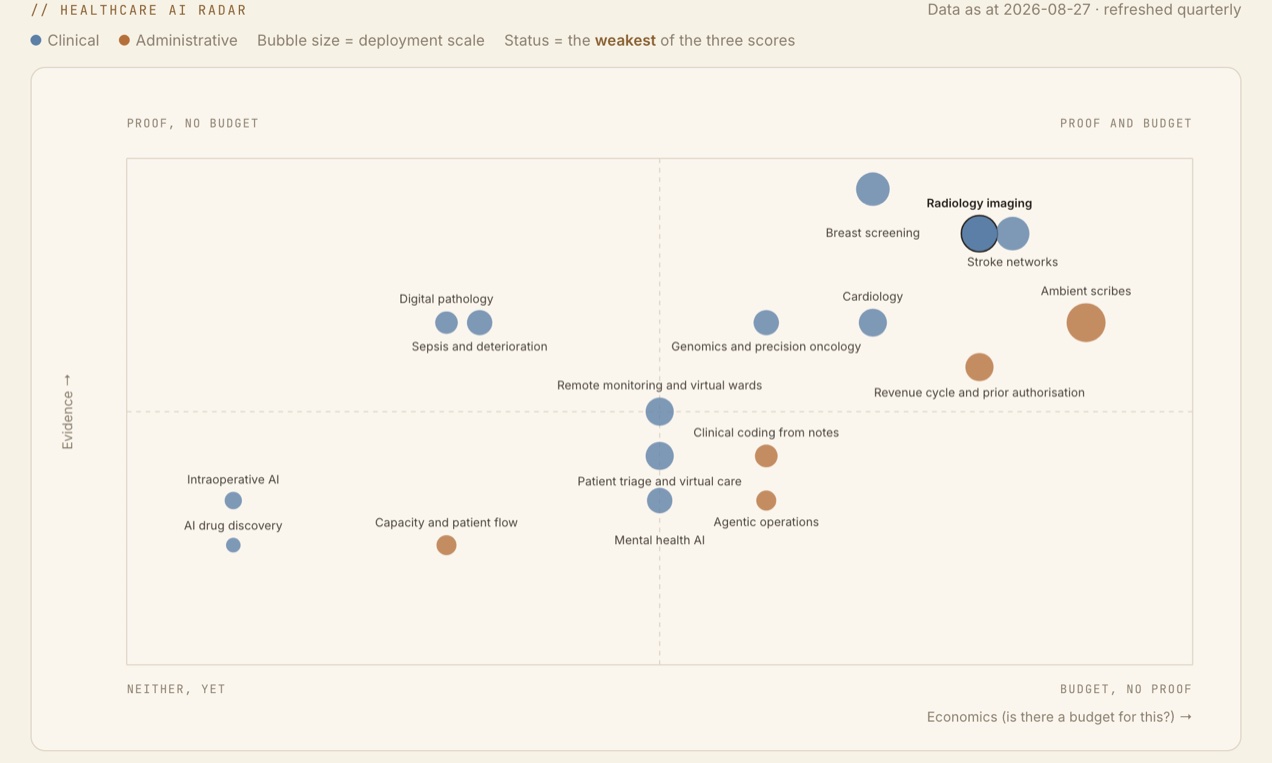
On the Healthcare AI Radar this is why two categories score the way they do. Ambient scribes and patient triage both get a lift on the economics leg that they would not have in a market where the buyer stayed quiet. A national buyer naming your category and attaching a budget is about as strong a demand signal as exists.
But a pre-announced demand is not the same as a closed sale, and this is where founders get hurt.
I run a second Ortent tool, the NHS Board Radar, an interactive map that scores every English health system, and now all 36 integrated care boards, on what their own board papers actually say. In October, AI appeared in the papers of 94 percent of the organisations it tracks, up from 63 percent in August. That sounds like the whole NHS has moved. It has not. More than half of the organisations that mentioned AI for the first time only name it or say they are exploring it. Fourteen are running operational pilots or partial rollouts. None yet shows a measured benefit that has lasted more than one period.
That gap, between the national announcement and what a local board has actually done, is where sales cycles go to die.
A founder reads the ten-billion-pound headline and builds a forecast on it. The forecast assumes the buyer is the NHS, singular. But the NHS does not buy. Integrated care boards and trusts buy, one at a time, on their own timetable, and most of them are still naming AI rather than paying for it. The money is real and the intent is published, but the cheque is signed locally, by a board that may be twelve to eighteen months behind the press release.
So the pre-announced demand changes your strategy in two specific ways.
First, it tells you what to build and what to claim. If your product sits in a category the NHS has named, you are selling into stated demand, and your job is evidence and accreditation, not persuasion. If it does not, you are creating demand from scratch, which is a slower and more expensive motion, and you should price and resource it as such.
Second, it tells you how to qualify a buyer. The right question for any NHS prospect is not "does the NHS want this", because the answer is published. It is "has this board actually moved". A system whose papers show an approved business case or a live rollout is a budget conversation you can join now. A system that only mentions AI needs the conversation started, and that is a longer arc. Both are real. They are different work, and you should not price them the same.
The lesson holds beyond the NHS. When a large buyer pre-announces demand, the winners are not the ones who cheer the headline. They are the ones who read it precisely: which categories were named, which evidence bar was set, and which individual buyers have actually crossed from announcement to action.
The Healthcare AI Radar scores every category on evidence, deployment and economics, including the demand the NHS has now made explicit, at ortent.co/tools/healthcare-ai-radar. The NHS Board Radar's interactive map, which measures the delivery gap board by board, is at ortent.co/tools/nhs-board-radar.