
The one category of healthcare AI that has unambiguously landed is not a clinical breakthrough. It is a note-taker.
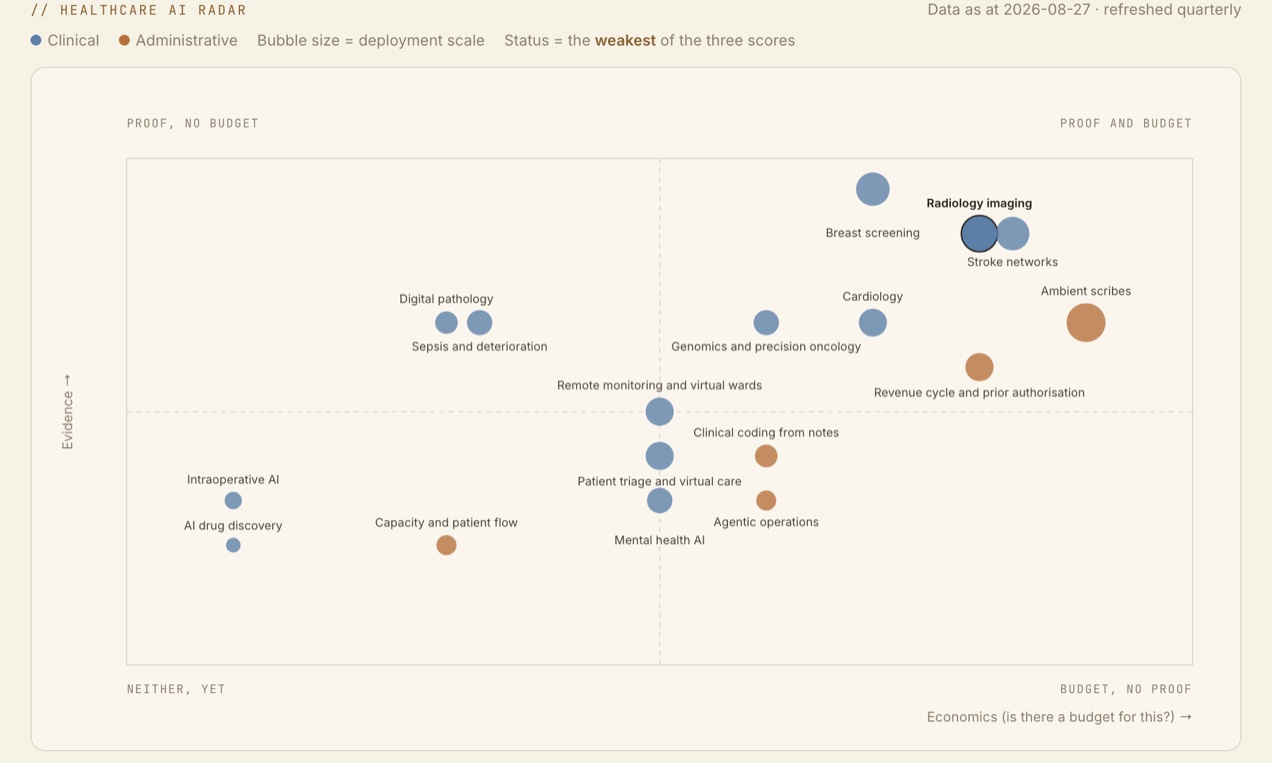
Ambient scribes listen to a consultation and draft the clinical note. On the Healthcare AI Radar they score higher on deployment than anything else on the board. More than 70 percent of large US health systems have deployed or are piloting one. Abridge is in over 300 health systems. Microsoft's DAX is in more than 600 organisations. In the NHS, ambient voice is going in system-wide, and a trial led by Great Ormond Street across nine London sites found clinicians spent nearly a quarter more time actually looking at the patient. That is the fastest adoption curve health IT has produced, and it happened in about eighteen months.
It is tempting to look at that and conclude the scribe is the product. It is not. The scribe is the wedge.
Here is the ladder it sits on. Think about how much a piece of AI is trusted to do. First it flags: it draws a human's attention to something. Then it triages: it re-orders the queue. Then it drafts: it produces work a human signs off. Then it acts: it does the thing without a human checking each case. Almost everything deployed at scale in healthcare today stops at draft. The step from draft to act is the commercial and regulatory cliff-edge, and it is the largest unclaimed prize on the map.
The scribe is the cleanest wedge into that ladder because it starts on the safest rung. It drafts a note a clinician signs. Nobody is harmed if it is wrong, because a human reads it. That is exactly why it spread so fast.
But look at what sits one rung up. Once the machine is already in the room, listening, the next products almost write themselves. Clinical coding from the same note. Order drafting. Referral letters. Care navigation. Each of those is a real category on the radar, and each one crosses further into regulated territory than the last.
That is the part most people miss, and it is where the money and the risk both sit.
In July 2026 the MHRA drew the line in plain terms. Software that transcribes, summarises, drafts, or suggests codes for a human to review is not a medical device. Software that supports a diagnosis, a treatment decision, or an automated action is a regulated device. The scribe sits comfortably on the safe side. The moment a scribe-maker adds "and here is the likely diagnosis", or "and I have queued these orders", it has walked across the line, and the regulatory clock starts. Companies that misjudge their lane lose a year.
So the scribe market is not really a market for notes. It is a land-grab for the relationship, the data and the workflow position from which you climb the ladder. The winners will not be whoever writes the best note. They will be whoever climbs one rung at a time without falling off the regulatory cliff, and whoever has the evidence and the payment route ready when they reach the rung that needs them.
This is exactly what scoring a category on three maturities shows you that a single score cannot. Scribes have landed because evidence, deployment and a payment route all arrived together on the safe rung. Coding from notes, the very next rung, scores lower, because the evidence and the economics have not caught up with the ambition yet. The gap between those two categories is the roadmap.
If you sell ambient AI, or you sit on a board deciding what to buy, the question is not "is the scribe any good". It is "which rung is this company actually on, which rung are they trying to climb to, and do they have the evidence and the regulatory read to survive the climb".
The Healthcare AI Radar scores all seventeen categories this way, scribes and every rung above them, at ortent.co/tools/healthcare-ai-radar. The whitepaper sets out the autonomy ladder and the regulatory line in full.