
Most maps of AI in healthcare give each category a single score and a colour. Hot, or not. That score hides the only thing worth knowing.
I have spent the summer building the Healthcare AI Radar. Seventeen categories of AI in healthcare, clinical and administrative, each scored on three separate maturities. Evidence, deployment, economics. Not one number. Three.
Evidence is independent, prospective results on a population like the buyer's. Not a vendor benchmark. Not an internal validation. Not a press release with an AUROC in it. Deployment is routine use at scale in real services, not a pilot, and especially not a pilot that has run for over a year without converting. Economics is a repeatable way to get paid: a reimbursement code, a national procurement route, or a return-on-investment case a chief financial officer has actually signed. In one word, a budget.
Each is scored zero to ten. The status of a category is set by the weakest of the three, not the average, because the weakest leg is the one that decides. Score all three, take the minimum, and read the gaps. That is the whole method. The gaps between the three scores are not noise. They are the diligence questions.
Here is why it matters, in one comparison.
Breast screening has the strongest evidence on the board. The MASAI trial in Sweden was a randomised controlled trial across more than 105,000 women. AI-supported reading found 29 percent more cancers with no rise in false positives, and cut the radiologists' screen-reading workload by 44 percent. The final results showed 12 percent fewer interval cancers. That is what evidence looks like when it is real.
Now the warning. The Epic Sepsis Model was switched on across hundreds of American hospitals on the strength of the vendor's own figures. When independent researchers validated it at the University of Michigan, the area under the curve was 0.63, not the 0.76 to 0.83 the vendor described. It missed 67 percent of sepsis cases while firing alerts on 18 percent of all patients. Same class of problem as the breast work. Opposite method, opposite result.
So the single most useful question in healthcare AI is the one the three-maturity read forces you to ask. Is there independent, prospective evidence on a population like mine, or only internal benchmarks?
Now lay all seventeen categories out and the shape of the market appears.
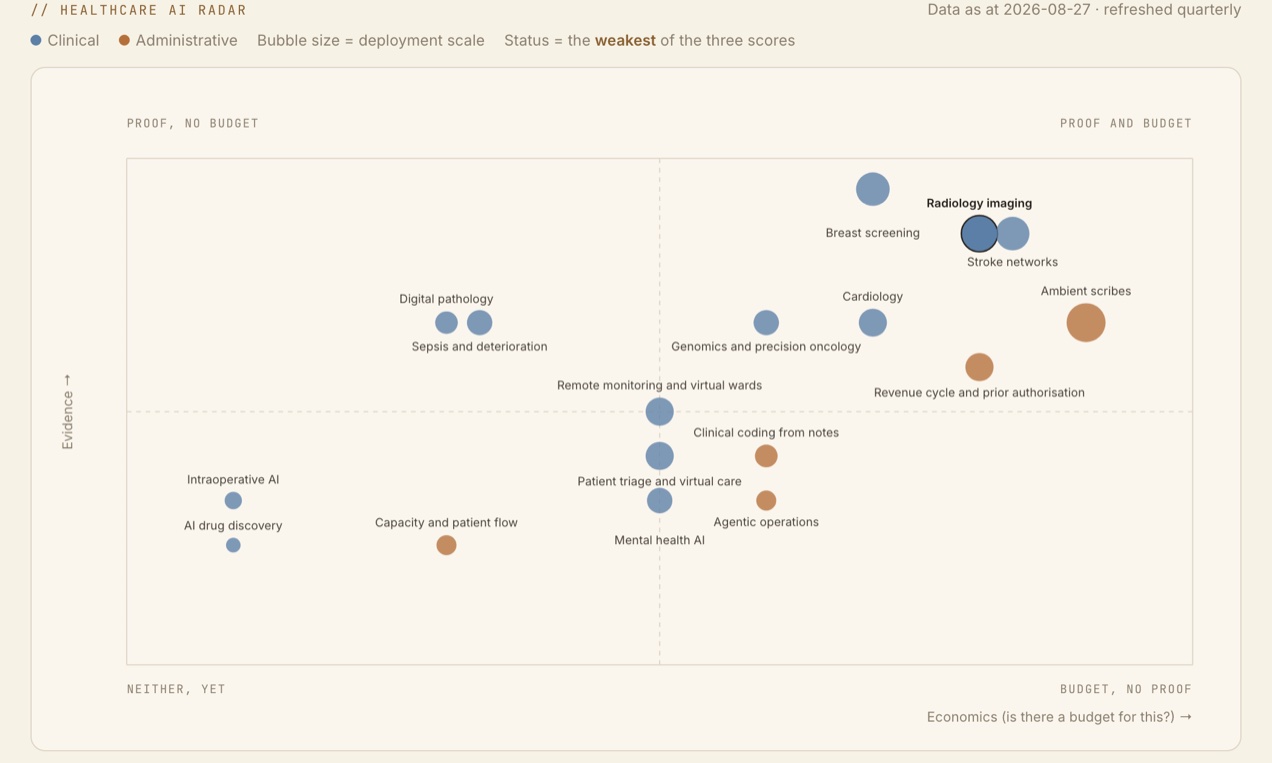
A handful have landed, meaning all three legs are strong. Radiology imaging, where the FDA has now cleared more than 1,100 AI algorithms, three quarters of every AI device it has ever authorised. Stroke networks, where the value is often in the pathway, not the pixel. Breast screening. And on the administrative side, ambient scribes, the fastest adoption curve health IT has ever produced.
A handful are on watch, meaning at least one leg is near zero. Intraoperative AI, the highest-stakes white space on the map. AI drug discovery, which has raised billions while not one leg is proven end to end. Capacity and patient flow, perennially promised and stubbornly hard.
The interesting ones sit in between, where the legs disagree. Sepsis and digital pathology both have repaired evidence and no real payment route: proven, but unpaid. That gap is the whole story.
The reason to look now rather than a year ago is that one leg just moved for the entire clinical side. For a decade the criticism of clinical AI was that nobody pays for it. That changed in 2026. New billing codes for clinical AI, national reimbursement for AI cardiac analysis, and from October a Medicare add-on payment for FDA-cleared inpatient AI worth up to a couple of thousand dollars a case. The economics leg, the one that held everything back, is forming in real time. Which means the categories with proven evidence and no budget are the ones about to re-rate.
The radar is free and it is live. Seventeen categories, the three scores behind each, the dated evidence, the example players, and what would move each one. There is a thirteen-page whitepaper that makes the full argument, a dataset you can download, and a prompt that scores your own company on the same three maturities and checks which regulatory lane you are in.
If you are building, buying or backing healthcare AI, the map is at ortent.co/tools/healthcare-ai-radar. Start with your category. Find your weakest of the three legs. That is the one that decides whether you scale.